Salary Sacrifice vs Business Contract Hire: Making the Right Choice for Your Business
.png)
Understanding the pros, cons, and tax savings of Salary Sacrifice and how it compares to Business Contract Hire for SME fleets.
Salary Sacrifice vs Business Contract Hire: Which Makes More Sense for Your Business?
Until recently, Salary Sacrifice car schemes were something only large corporations could access. But as leasing funders open up their products to smaller firms, it’s now becoming a popular option for SMEs who want to offer electric vehicles to staff while saving money in the process.
At Kinetic Vehicle Leasing, we’ve seen a noticeable rise in interest from business clients who want to understand whether Salary Sacrifice could work for them, or if Business Contract Hire (BCH) remains the better fit.
Here’s a quick, practical guide to help you decide.
What is Salary Sacrifice?
Salary Sacrifice allows an employee to give up part of their gross salary in exchange for a company-supplied vehicle, usually an electric or ultra-low emission car. Because the deduction comes from gross pay (before tax and National Insurance), both the employer and employee make savings.
The employee pays Benefit-in-Kind (BIK) tax on the vehicle, but because BIK rates for EVs are currently so low, the savings can be substantial. For the employer, it can also reduce National Insurance contributions and support sustainability goals.
How it compares to Business Contract Hire
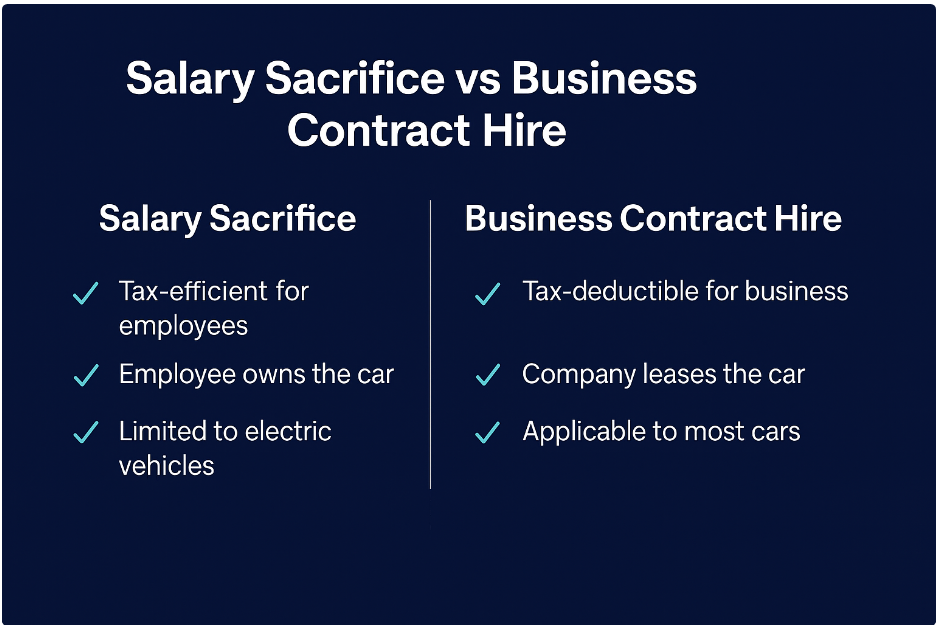
| Salary Sacrifice | Business Contract Hire (BCH) | |
|---|---|---|
| Vehicle ownership | Employer leases on behalf of employee | Employer leases for company use |
| Tax benefits | Employee saves on BIK and NI | Corporation tax relief on rentals |
| Eligible vehicles | Usually electric or ultra-low emission | Any vehicle type |
| Risk | Employer liable if employee leaves early | Business retains control |
| Use case | Personal use by employee | Business or shared use |
Both methods are forms of leasing, but the key difference lies in who the vehicle is for and how the tax benefits apply.
A real-world example
Let’s take a Hyundai IONIQ 5 Premium as an example.
If an employee leased this car personally on a 3-year agreement, they might expect to pay around £650 per month after tax, insurance, and maintenance.
Under a Salary Sacrifice arrangement through their employer, the same car could cost closer to £420 per month.
That’s a saving of around £230 per month (or nearly £8,000 over three years) for the employee.
Here’s how that works:
-
The payment is taken from their gross salary, so they pay less income tax and National Insurance.
-
The car’s BIK rate is just 2% until at least April 2025, which means very little taxable benefit compared to a petrol or diesel car.
-
The employer also benefits by saving on National Insurance contributions and demonstrating their commitment to lower emissions.

The pros and cons
Salary Sacrifice advantages:
-
Significant tax and National Insurance savings
-
Helps attract and retain staff
-
Supports sustainability targets
-
Fixed monthly costs including maintenance and breakdown cover
Salary Sacrifice disadvantages:
-
Employer liability if an employee leaves mid-contract
-
Mainly limited to electric vehicles
-
Slightly more admin to manage
BCH advantages:
-
Simple and familiar funding method
-
Flexibility to choose any vehicle
-
Corporation tax relief on rentals
-
Easy to scale as the business grows
BCH disadvantages:
-
No personal tax benefits for drivers
-
Less attractive as a staff incentive
What to consider before you decide
For smaller businesses, the decision often comes down to practicality. BCH remains the simplest and most flexible option for company vehicles. Salary Sacrifice, while slightly more complex to manage, can be an excellent tool for attracting staff, improving retention, and supporting sustainability goals.
If you are considering a Salary Sacrifice scheme, it’s important to work with a leasing partner who understands the compliance, payroll, and HR integration needed to make it run smoothly.
Final thoughts
Salary Sacrifice is no longer just for large organisations. With the right setup, SMEs can use it to reduce costs, reward staff, and move towards a greener fleet. Business Contract Hire still has its place, but Salary Sacrifice offers something genuinely different: a tax-efficient way to drive an EV that benefits both employer and employee.
If you’d like to explore how either option could work for your business, Kinetic Vehicle Leasing can help you compare the two and find the right approach for your needs.
Ready to explore how Salary Sacrifice or Business Contract Hire could work for your business?
Get in touch with the team at Kinetic Vehicle Leasing and we’ll help you find the most tax-efficient, cost-effective solution for your fleet.